
If you are engaged in air compression systems, robotics or industrial automation, you must know that time is money. Traditional pipeline connection methods involving glue, welding or threads are usually slow and lack fault tolerance. At this time, the push-in fitting has become the standard configuration for professionals to connect pneumatic system pipelines.
We’ll discuss everything about these connectors from how they work to best practices for installation in this article.
What Are Push-in Fittings?
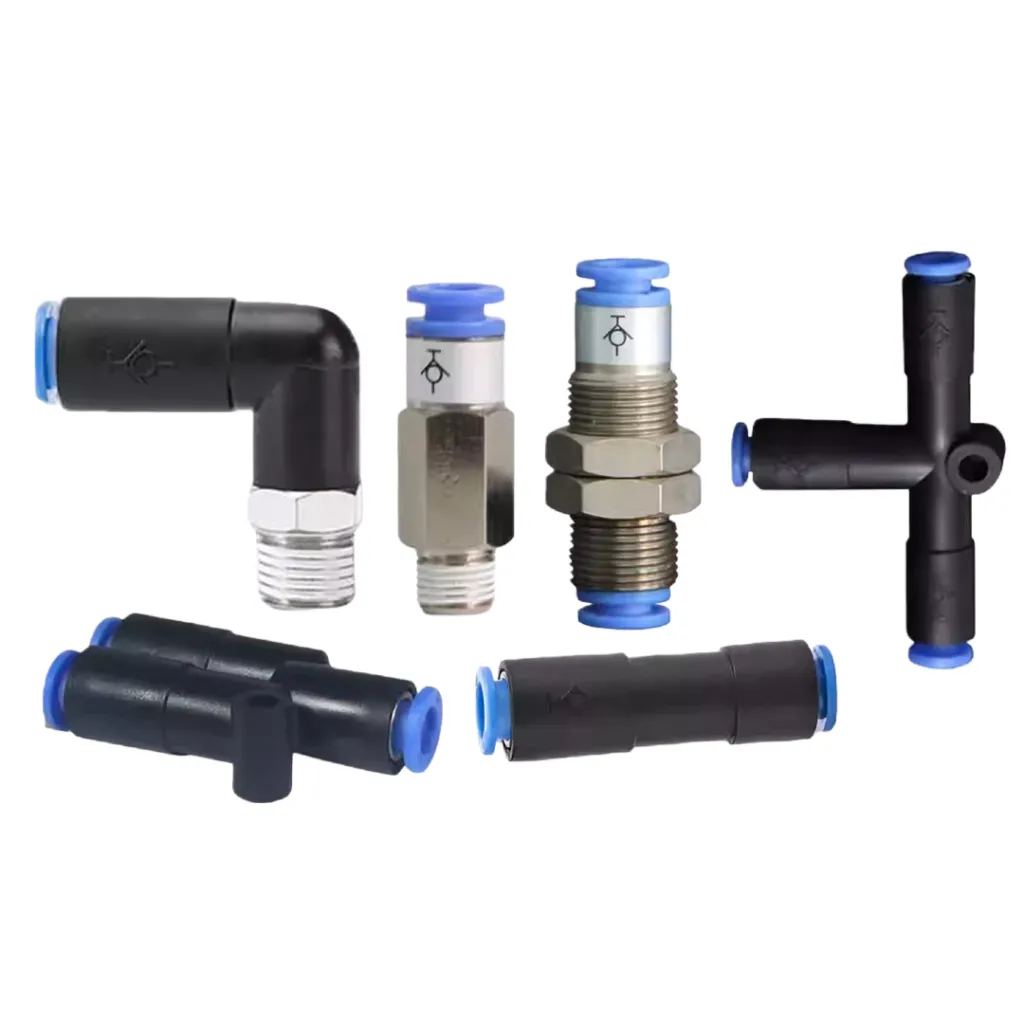
Push-in fitting (also known as push-to-connect fitting or one-touch fitting) is a compression coupling used to easily connect hoses and pipes. They are mainly designed for pneumatic (air) applications, but sometimes also for low-pressure fluid systems.
The feature is simplicity: You don’t need a wrench, clamp or adhesive. Simply push the tube into the fitting and it will lock in place that greatly shortens the assembly time and minimizes the risk of operational errors.
Why are they Critical to Modern Pneumatic Systems?
Flexibility is the key in the automation field. Pneumatic push-in fitting allows engineers to quickly build complex air circuits and quick disassembly. If you need to rewire, you can release the pipe as easily as when you insert it, which makes these connectors indispensable for maintenance and prototyping.
How Does Pneumatic Push-in Fitting Work?
The standard push-in fitting depends on two internal mechanisms:

- The Collet (Grab Ring): A stainless steel ring with inward inclined teeth. When you insert the tube, the teeth allow it to slide smoothly. However, if you try to pull the tube backwards, the teeth will bite into the material and lock it firmly.
- The O-Ring: Made of NBR (nitrile rubber) or Viton (fluorine rubber). The O-ring forms an airtight seal outside the tube, which can prevent air from escaping even under high pressure.
ANRUK Team Note: To release the tube, simply press Release Collar downwards. This action will recover the teeth of the sleeve and allow the tube to slide out without damage.
Types of Push-in Fittings
You need to choose the right material according to your environment: clean room, flushing area or standard workshop.
The following table lists the differences between different materials in detail to help you choose the push-in fitting that suits your needs.
| Push-in Fittings Material Comparison Table | |||
|---|---|---|---|
| Material | Best Application | Pros | Cons |
| Plastic (Composite) | General Pneumatics, Automation | Lightweight, low cost, widely available. | Can crack under extreme physical impact; lower heat resistance. |
| Nickel-Plated Brass | Industrial Air Lines | Durable, corrosion-resistant, high strength. | Heavier and more expensive than plastic. |
| Stainless Steel | Food & Bev, Chemical, Medical | Highest corrosion resistance, withstands washdowns. | Most expensive option; overkill for standard air tools. |
Shape Configurations
In order to effectively guide the airflow, push-in fitting have various shapes:
- Straight Unions: Connect two pipes in a straight line.
- Elbows (90 °): Allow sharp turns without kinking the hose.
- Tees (T-Shaped): Divides an airflow into two directions.
- Bulkheads: Designed to allow tubes to pass through panels or walls.
Benefits of Push-in Fittings
Why switch from standard compression fitting or hose barbs fitting to push-in fitting? The following are undeniable advantages:
Speed: Installation takes only a few seconds, not minutes. There is no need to tighten the nut or wind the sealing belt on the connecting side.
Tool-Free Assembly: Your hands are the only tool needed to connect and disconnect.
Reusability: Unlike crimped joints, these joints can be used repeatedly (provided the internal teeth are not damaged).
Flow Rate: Provide full flow characteristics with minimal turbulence, ensuring that your pneumatic tools get the power they need.
Compact Design: Very suitable for the narrow space where the wrench cannot be used.
How to Install Push-in Fittings Correctly?
Although push-in fitting is easy to use, incorrect installation can cause an air leakage. Please follow steps to ensure a stable connection every time.
Step 1: Cut the Tubing Square
You must cut the air pipe at a 90-degree angle. If the notch is tilted, the O-ring may not properly seal the tube wall.
The ANRUK team note: Use a specialized pipe cutter instead of scissors or wire pliers, as the latter will flatten the tube.
Step 2: Clean the Surface
Ensure that there are no scratches, dust or debris at the end of the tube. Scratches on the outer diameter of the tube will become a channel for air to escape around the O-ring.
Step 3: Insert the Tube
Push the tube hard into push-in fitting. You will feel it go through the clamp (slight resistance) and then hit the bottom stopper.
Check: Gently pull the tube after insertion. It should not come out. This pull-out test confirms that the collet is engaged.
Step 4: System Pressurization
Carefully listen to whether there is a hiss sound after turning on your air supply. If installed correctly, the connection should be muted and pressure maintained immediately.
Common Applications of Push-in Fittings
Pneumatic push-in fittings are common components in different industries.
Industrial Robotics
The manipulator needs a flexible pipeline that can move quickly. Push-in fittings realize lightweight connections that don’t depress the arm or restrict movement.
Automotive Manufacturing
The assembly line of automotive manufacturing relies on pneumatic tools. These push-in fittings make the maintenance team to immediately replace damaged hoses and reduce downtime.

Food and Beverage Packaging
Using stainless steel push-in fittings, manufacturers can maintain hygienic standards that allow chemical flushing while delivering air to the packaging machine.
3D Printing (Bowden Tubes)
If you have a 3D printer, you may find a push-in fitting holding your PTFE tube (Bowden tube). It guides the consumables from the extruder to the hot end.
Troubleshooting: Why is My Push-In Fitting Leaking?
Even the expensive push-in fitting will leak if improperly used. If you hear air escaping, check these common culprits:
- Tube Cutting Angle Tilt: Remove the tube, re-vertical cutting and then re-insert.
- The Pipe has Scratches: if the pipe end has scratches, the O-ring cannot be sealed. Cut off the damaged part (about 1 inch) and reinsert.
- Debris: The dirt in the joint may cause the O-ring to be unable to be in place.
- Incompatible Size: Make sure you do not Metric (mm) tubes and imperial-inch fittings. Although it looks similar, the 6mm tube cannot be sealed in a 1/4′ fitting.
For in-depth technical specifications for pipeline standards, you can refer to resources such as Engineering ToolBox, which provides data on pressure levels and material compatibility.
Conclusion
By understanding the different materials, mastering the installation techniques and conducting regular inspections, you can ensure a safe, leak-free environment.
Whether you’re building complex automation equipment or just a repair shop compressor, investing in high-quality pneumatic push-in fittings ensures that your system runs smoothly and safely.
Looking for more pneumatic advice? Please see our guide on [ comparison about brass or plastic fitting ] and [ understanding pneumatic fittings ] to ensure that your workshop maintains the best performance.
FAQ
Can I use Push-in Fitting for water?
Although mainly designed for air, many plastic and stainless steel push-in fittings are water-compatible, provided that the system pressure is low and the temperature is within the manufacturer’s range. Please be sure to check the specification table first.
What is the maximum pressure of pneumatic push-in fitting?
Most standard push-to-connect fittings are rated up to 150 PSI (10 Bar). However, heavy metal versions can withstand higher pressures.
Can it be reused after removing the tube?
Yes, but the metal teeth of the fitting will leave scratches on the pipe. Before reusing the same end, the best practice is to cut off the scratched part to ensure that the O-Ring has a new sealed surface.


